EAC, I-REC & Carbon Market Intelligence Platform
Hestiya Intelligence brings EAC intelligence, I-REC intelligence and carbon market intelligence into one platform. Track live I-REC and EAC (Energy Attribute Certificates) prices across 50+ countries, follow carbon credit pricing by project type, and drill into the projects, issuers and certificate volumes behind each number. Prices come from daily registry and marketplace data, cleaned and volume-weighted using our published methodology, so procurement, sustainability and trading teams can compare markets, spot trends early and make carbon and renewable energy decisions with confidence.
EAC Market Intelligence: Prices, Trends and Analytics
An Energy Attribute Certificate (EAC) is only useful if you can see where it's trading and at what price. Hestiya Intelligence consolidates EAC activity — I-RECs, GO, GEC, REC, REGO, and YEK-G — into a single view, so procurement and trading teams aren't cross-referencing six separate registries to answer one question: what's the market doing right now?
Global Markets
Explore I-REC (EAC) market activity across regions worldwide.
Price Intelligence
Access real-time I-REC (EAC) pricing across every tracked market.
Market Trends
Spot shifts in I-REC (EAC) demand, supply, and pricing early.
Market Analytics
Compare markets, technologies, and vintages with structured analytics.
Project Intelligence
Drill into individual projects, issuers, and certificate volumes.
Procurement Insights
Turn market data into faster, more confident procurement decisions.
I-REC Market Intelligence and Price Tracker
I-RECs are the default EAC standard across most of Asia, Africa, Latin America, and the Middle East — which also makes them the certificate type with the most fragmented pricing data. Hestiya pulls I-REC transaction data daily, maps it against project location and technology, and turns it into a live pricing view you can filter by country, vintage, and generation type.
Real-Time I-RECs (EAC) Market Analytics & Satellite Mapping
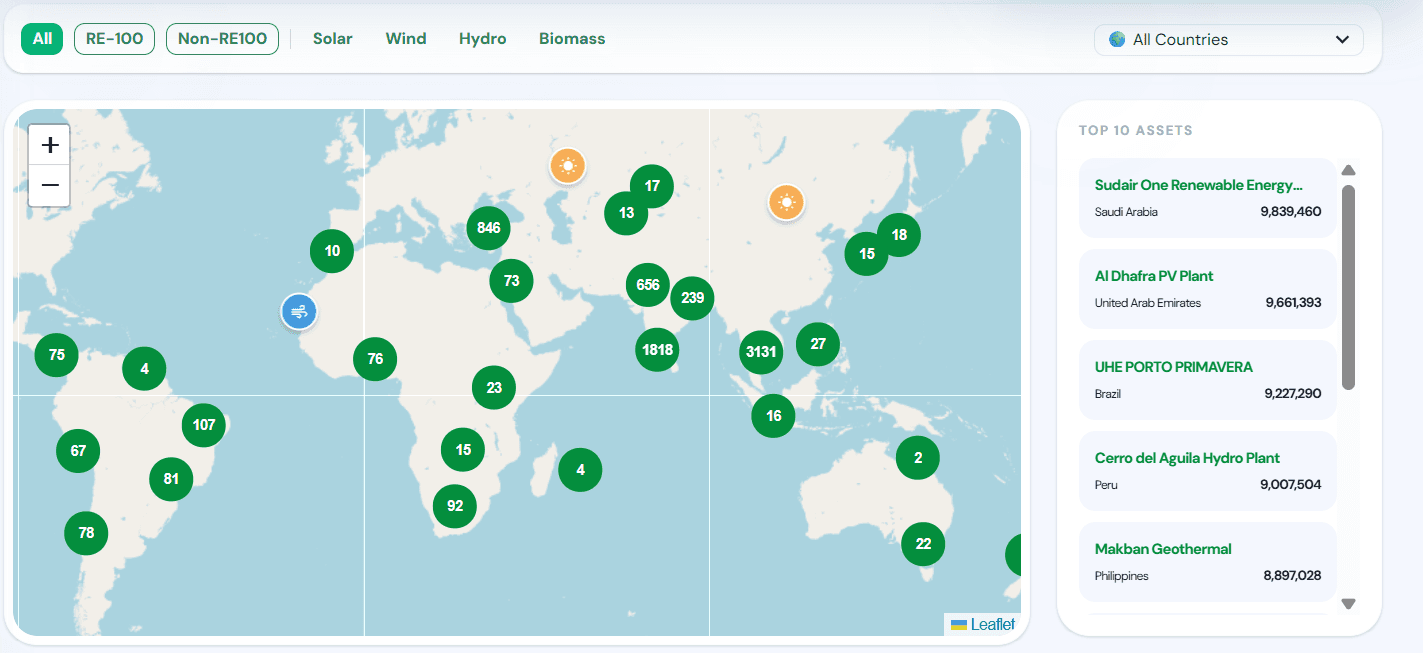
Hestiya Intelligence pairs interactive satellite maps with live I-RECs (EAC) market analytics pricing data, so you can see exactly where renewable energy technologies and project activity are concentrated. Combine that geographic view with real-time market participants data, and procurement teams get the full picture needed for informed, confident procurement decisions.
Global & Regional I-RECs (EAC) Market Views
Switch between a global overview and country-level views of the global I-RECs market to compare activity, pricing, and project counts across regional I-RECs market and country-level EAC data side by side.
I-RECs (EAC) Price Discovery & Market Analytics
Access live and historical I-RECs price discovery data to assess current market conditions, review I-RECs (EAC) historical pricing, and compare movement across markets and time periods using built-in market analytics tools.
RE100 & Non-RE100 Asset Classification
Filter certificates by RE100 eligible certificates status to quickly identify assets that qualify for RE100 renewable energy commitments, or review non-RE100 assets separately when sourcing for other corporate sustainability goals.
I-RECs (EAC) Pricing Trends & Historical Market Data
Our Pricing Methodology
Every price on Hestiya Intelligence goes through the same three-step process. First, Data Ingestion: our systems pull data daily via API directly from registries and marketplaces. Second, Normalization & Cleaning: figures are standardized, outliers are flagged and reviewed, and all prices are converted to a common currency. Third, Volume-Weighted Average: we calculate the final price using a volume-weighted average EAC price calculation method, so high-volume trades carry proportionally more weight than one-off outliers.
Explore the Global I-RECs (EAC) Registry
Identify, Analyze & Procure Renewable Energy Certificates
Every listing in the I-RECs (EAC) registry links back to verifiable project and registry data, covering both established markets and emerging ones. Browse renewable energy project registry records and I-RECs registry data side by side to identify, analyze, and procure with confidence.
Ready to act on what you find? List or trade certificates directly on the Hestiya Marketplace.
Carbon Market Intelligence: Credit Prices, Projects and Trends
Carbon credits don't trade on a single exchange, which makes price discovery harder than it is for equities or even EACs. Hestiya tracks verified carbon credit transactions across major registries and project types, so you can see current pricing, project-level detail, and where the market is moving before you commit to a purchase.
Our Carbon Pricing Methodology
Carbon credit pricing on Hestiya follows the same three-step discipline as our EAC pricing. First, we ingest transaction and listing data daily from registries and project developers. Second, we normalize it — standardizing currency, flagging duplicate or stale listings, and separating credits by project type (nature-based, renewable energy, methane capture, direct air capture, and so on) since these rarely trade at comparable prices. Third, we apply a volume-weighted average within each project category, so a handful of large trades don't quietly skew the number you're looking at.
Carbon Credit Project Registry
Every carbon listing on Hestiya links back to its underlying project — developer, registry standard (Verra, Gold Standard, ACR, and others), vintage year, and verification status. Browse by project type or country to see not just the price, but what's actually generating the credit.
Carbon Market Trends
Voluntary carbon markets move on a different rhythm than EAC markets — corporate net-zero commitments, registry methodology updates, and nature-based project supply all shift pricing in ways that don't map cleanly onto renewable energy demand. Hestiya's trend tracking separates these signals out by project category, so a slowdown in one segment (say, REDD+ credits) doesn't get read as a market-wide trend when it isn't one.
EAC & Carbon Credit Market Data by Country
With Carbon Market Intelligence layered in alongside EAC pricing, this is the one place to check both sides of a country's climate market — certificate standard and carbon project activity — before you compare it against another region.
Every market trades under its own certificate standard. I-RECs covers most of Asia, Africa, Latin America, and the Middle East, while China uses GEC and Turkey trades both I-RECs and YEK-G. Explore EAC I-RECs country market data and carbon credit market data by country below.
India I-RECs Market
Country-specific pricing, projects, and carbon credit data.
Brazil I-RECs Market
Country-specific pricing, projects, and carbon credit data.
China GEC Market
China trades under its own GEC standard; I-RECs issuance was discontinued here in March 2025.
Vietnam I-RECs Market
Country-specific pricing, projects, and carbon credit data.
Thailand I-RECs Market
Country-specific pricing, projects, and carbon credit data.
Malaysia I-RECs Market
Country-specific pricing, projects, and carbon credit data.
Mexico I-RECs Market
Country-specific pricing, projects, and carbon credit data.
Chile I-RECs Market
Country-specific pricing, projects, and carbon credit data.
Colombia I-RECs Market
Country-specific pricing, projects, and carbon credit data.
Nepal I-RECs Market
Country-specific pricing, projects, and carbon credit data.
Turkey I-RECs & YEK-G
Turkey trades both I-RECs and its domestic YEK-G certificate side by side.
Everything You Need to Navigate the Global I-RECs (EAC) & Carbon Market
Hestiya Intelligence brings certificate switching, technology filters, RE100 classification, vintage pricing, leaderboards, and satellite mapping together in one I-RECs (EAC) platform.
I-RECs, GEC & GO Certificate Switching
Toggle instantly between certificate standards by market using I-RECs GEC GO switching, so you're always viewing data in the format your target market actually recognizes, without manual conversion.
Technology-Level Filtering
Apply a renewable technology filter to break pricing and volume data down by solar wind hydro biomass certificates, so you can compare like-for-like generation types across markets.
RE100 & Non-RE100 Classification
Use RE100 classification filters to isolate certificates suited for RE100 compliant sourcing, cutting research time for corporate buyers working against a specific commitment deadline.
Vintage-Based Pricing
Compare the broader market average against a specific vintage I-RECs pricing year, so you know exactly how much a vintage year certificate price premium or discount actually costs.
Top Asset Leaderboards
Rank top renewable energy assets by issuance volume, tagged by country, so you can spot the highest-volume projects in the certificate issuance leaderboard at a glance.
Interactive Satellite Maps
Visualize projects geographically down to the country and individual asset level using satellite map renewable projects data, an interactive EAC map built for procurement research.
The Global EAC Landscape
EAC is one universal concept with different regional names. Depending on where you operate, the same underlying certificate might be called I-RECs, GO, REC, REGO, GEC, or YEK-G.
EAC: Energy Attribute Certificate
An EAC, or Energy Attribute Certificate, is the umbrella term for any certificate that proves one megawatt-hour of electricity came from a renewable source.
I-RECs: Asia, Africa, LatAm & Middle East
I-RECs certificates are the leading EAC standard in markets without their own local tracking system, covering most of Asia, Africa, Latin America, and the Middle East.
GEC: China
GEC, or Green Electricity Certificate, has been China's sole recognized renewable energy instrument since I-RECs issuance stopped there in March 2025.
GO: Guarantee of Origin (Europe)
Guarantee of Origin, or GO, is the European Union's equivalent EAC standard, used to track and certify renewable electricity generation across EU member states.
YEK-G: Turkey
YEK-G is Turkey's domestic equivalent of a Guarantee of Origin certificate, traded alongside I-RECs in the same market rather than replacing it.
REC: Renewable Energy Certificate (North America)
REC, or Renewable Energy Certificate, is the equivalent EAC standard used across the United States and Canada to track renewable electricity generation.
REGO: Renewable Energy Guarantees of Origin (UK)
REGO certificates are the United Kingdom's EAC standard, tracked separately from the European Union's GO system since the UK's departure from the EU.
New to EACs and Carbon Markets? Start Here
New to this space? Start with the three guides below to get comfortable with carbon markets explained and I-RECs basics.
What are Carbon Credits?
A carbon credit represents one tonne of CO2 either avoided or removed from the atmosphere. Buying credits helps fund verified climate projects while offsetting emissions you can't yet eliminate directly.
Read More →What is an EAC and an I-REC?
An EAC certifies that one megawatt-hour of electricity came from a renewable source. An I-REC is the most widely used type of EAC outside regions with their own domestic standard.
Read More →What is I-REC Market Intelligence?
I-RECs market intelligence turns raw pricing and project data into something usable: clear signals that support faster, more confident data-driven sustainability decisions for procurement and ESG teams.
Read More →Who Uses Hestiya I-RECs (EAC) Intelligence?
A wide range of teams rely on I-RECs (EAC) buyers intelligence and ESG procurement teams workflows every day:
Manufacturing Companies
Renewable Energy Developers
Carbon Project Developers
Carbon Traders
ESG Consultants
Sustainability Teams
Financial Institutions
Universities & Research Orgs
Industry Use Cases
Five ways different teams put I-RECs (EAC) use cases and renewable certificate use cases to work:
Procurement Timing
Check I-RECs procurement timing and carbon credit price monitoring before you buy, not after.
Demand Signals
Track I-RECs demand tracking patterns to spot renewable energy buyer signals before competitors do.
Faster Reporting
Pull verified ESG reporting data straight into client sustainability report data, without manual data hunting.
Market Opportunities
Analyze I-RECs trading opportunities using live certificate price movement analysis across every tracked market.
Verified Data
Study verified I-RECs data and carbon market research data without chasing down individual registries.
Frequently Asked Questions About EAC & I-REC Market Intelligence
An Energy Attribute Certificate (EAC) is an official document proving that 1 megawatt-hour (MWh) of electricity was generated from a renewable energy source. EAC is the global umbrella term covering regional standards such as I-REC in Asia, Africa, and Latin America, GO in Europe, and REC in North America.
An I-REC (International Renewable Energy Certificate) is a standardized EAC issued under the I-TRACK Foundation framework. It allows organizations across Asia, Africa, Latin America, and the Middle East to track, verify, and report Scope 2 renewable electricity consumption.
Carbon market intelligence is data and analysis on carbon credit prices, projects, registries and market trends. It shows what credits cost by project type, where supply is growing and how demand is moving, so buyers can compare options, time purchases and avoid overpaying before they commit.
EAC market intelligence tracks the prices, volumes, projects and trends of Energy Attribute Certificates across regions and standards. It gives procurement teams a single view of markets such as I-REC, GO, REC and GEC, instead of separate registry reports, so they can buy renewable certificates at the right time and price.
I-REC prices depend on the country, generation technology (solar, wind, hydro), vintage year, RE100 eligibility and trade volume. Hestiya collects daily transaction data, cleans it and calculates a volume-weighted average, so large trades count for more than one-off outliers. Prices vary by market because supply and corporate demand differ in each country.
Carbon credits trade across many registries and platforms rather than on one exchange, so prices vary. Project type, standard (Verra, Gold Standard), vintage, location and verification status all affect cost. Nature-based, renewable energy, methane capture and removal credits rarely trade at comparable prices, so averages are best compared within each category.
The difference depends on regional jurisdiction: RECs apply in North America, Guarantees of Origin (GO) apply in Europe, and I-RECs apply across most of Asia, Africa, Latin America, and the Middle East. All three serve the same purpose of documenting Scope 2 renewable energy attributes.
In the voluntary market, companies buy carbon credits by choice to meet climate or net-zero goals. In compliance markets, such as the EU Emissions Trading System, governments require companies to hold permits for their emissions. Hestiya's marketplace and intelligence products cover the voluntary market.
Unlock more than a login
Are You Ready to Make Better Decisions in the I-RECs (EAC) Market?
Join procurement, trading, and ESG teams already using Hestiya Intelligence to make faster, evidence-based I-RECs (EAC) decisions.